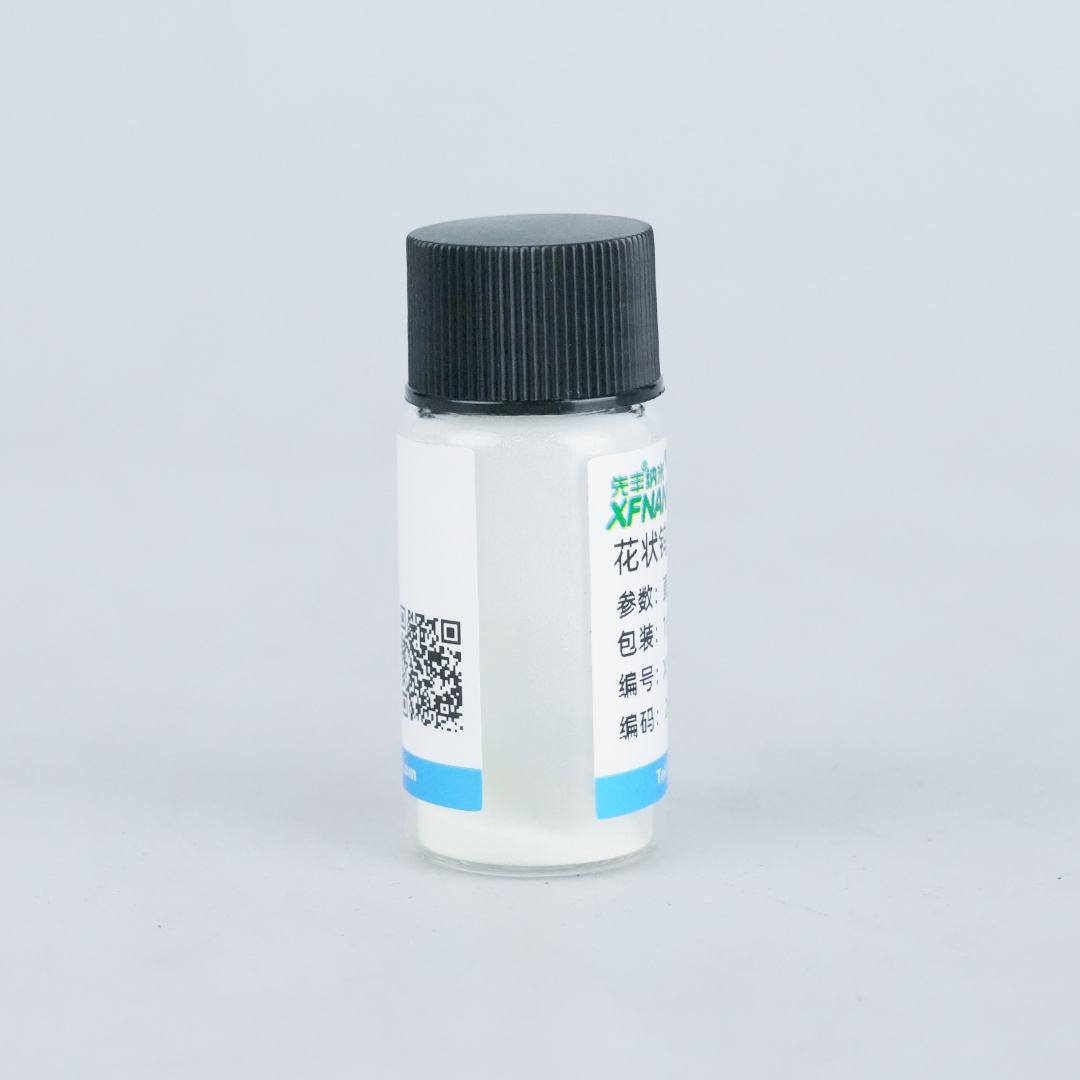
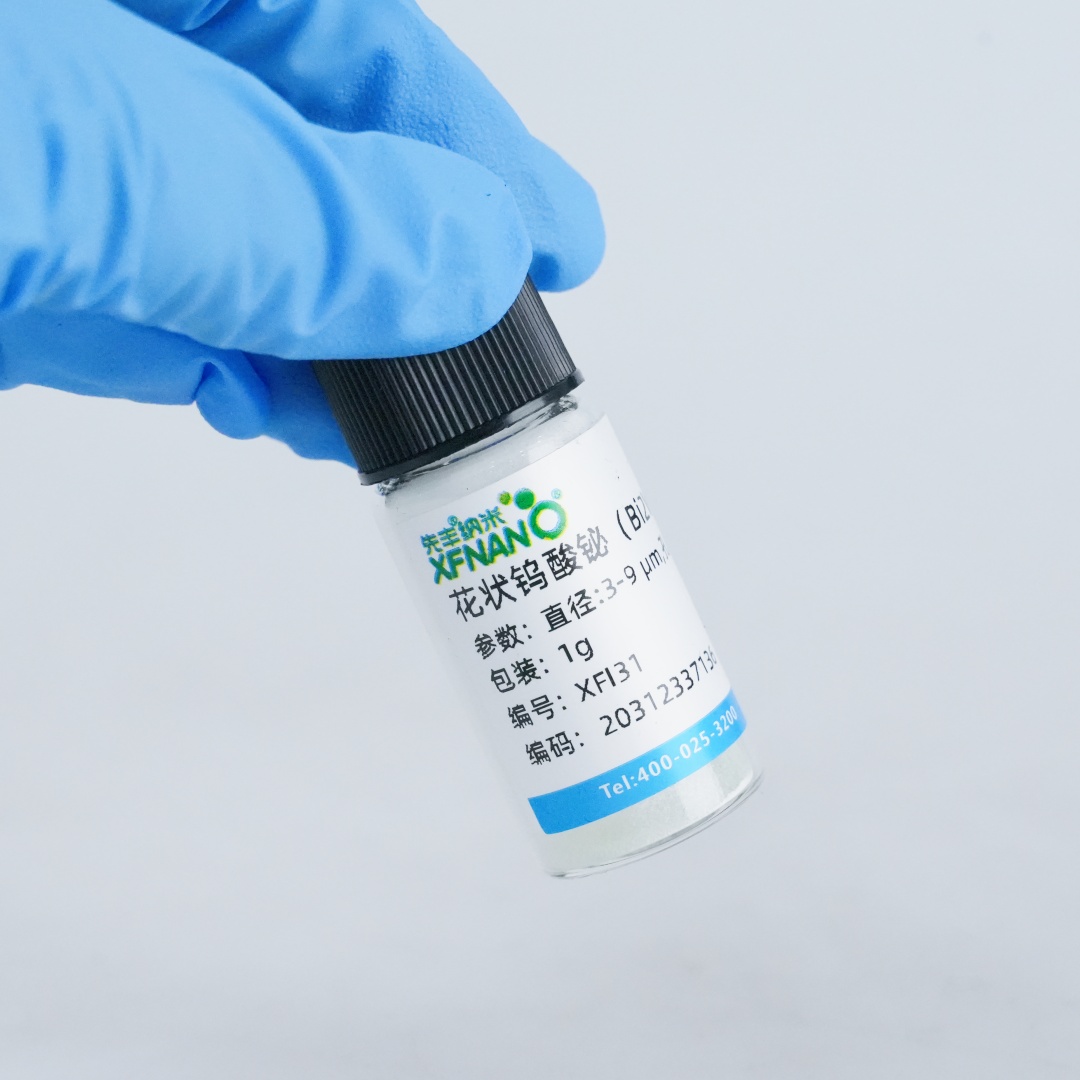

Flower-like Bi2WO6
NO.:103014 Code:XFI31
CAS:13595-87-4 Param:D:3-9 μm
Paproductckage:1g Expdate:365days
{{personLoading ? (english ? 'Finding your sales contact…' : '正在匹配服务人员…') : (english ? 'No QR code available. Please leave a message.' : '暂无可用二维码,请留言咨询。')}}

Product Name
Flower-like Bi2WO6
Product Overview
Flower-like bismuth tungstate (Bi₂WO₆) is a photocatalytic material with a special morphology and excellent properties, which, as its name suggests, exhibits a hierarchical structure resembling a flower. The structure is actually a combination of an ordered array of two-dimensional nanolayers, which are in turn composed of small nanosheets tightly stacked. The nanosheets typically have edge lengths of about 50 nm and thicknesses of about 20 nm. This hierarchically assembled structure gives the floral bismuth tungstate a unique morphology under the microscope, while endowing it with excellent physical and chemical properties.
Technical Parameter
Status:Light yellow powder
Diameter:3-9 μm
Pore diameter:~5.5nm
Specific surface area:~527 m2/g
Product Features
Thermal stability: Bismuth tungstate in flower form has good thermal stability and can remain basically unchanged at higher temperatures (e.g., 450°C), which provides the possibility of its application in high-temperature environments;
Photocatalytic activity: Due to its unique morphology and energy band structure, bismuth tungstate has excellent photocatalytic degradation activity for a variety of organic pollutants (e.g. Rhodamine B) under visible light irradiation. This activity mainly comes from its large specific surface area and the multiple scattering effect of light inside the hierarchically assembled structure, which increases the contact area and optical range length of light waves in the material;
Mechanical stability: Despite its seemingly ‘delicate’ appearance, floral bismuth tungstate is actually mechanically stable. For example, after 10 minutes of ultrasonic treatment in an ultrasonic cleaning tank, its shape remains essentially intact.
Application Fields
Photocatalysis: good degradation of organic pollutants under visible light irradiation, which can be used for wastewater treatment and air purification, e.g., capable of degrading dye wastewater, such as Rhodamine B and methyl orange;
Photoelectrochemistry: can be applied to photoelectrochemical batteries, e.g., for constructing photoelectrochemical sensors;
Catalytic reaction: in catalytic organic synthesis reaction, flower-like bismuth tungstate can be used as a catalyst to improve the reaction efficiency and yield;
Energy conversion: in the field of energy conversion such as hydrogen production from photolysed water, bismuth tungstate in flower form also shows certain application potential.
Related Information
Sealed, avoid light, and keep at room temperature, expiry date:one year.
Please e-mail for the detailed characterization data.
E-mail:sales@xfnano.com

光催化材料及应用是什么?这篇帮你整理好了
光催化是利用光能进行物质转化的一种方式,是物质在光和催化剂共同作用下所进行的化学反应。经过几十年的发展,光催化在污染物降解、重金属离子还原、空气净化、CO2 还原、太阳能电池、抗菌、自清洁等方面受到广泛应用研究,是国际上热门研究领域之一。本期小丰整理了几种常见的光催化材料以及应用情况,一起看下~
一、常见的光催化材料
1、金属氧化物
金属氧化物光催化材料有TiO2, Fe2O3,WO3,ZnO,Cu2O,SnO2 等等。TiO2 因其化学性质稳定、催化活性高、价格低廉、无毒无污染等优点而备受人们的青睐,是当今研究最多的光催化剂,除了1972年发表在 Nature上的开山之作,更有3篇关于TiO2 的文章发表 Science上。
2、g-C3N4
2009年,研究人员首次发现g-C3N4材料的光催化产氢效果显著,使得其在光催化领域的研究引起了轰动。石墨相氮化碳(g-C3N4),作为一种非金属半导体光催化剂,具有合适的禁带宽度,能在可见光下响应,其化学稳定性、热稳定性良好,可用于光催化有机合成、光催化降解有机污染物和光催化分解水制氢等。
3、金属硫化物
CdS、ZnS和MoS2 是硫化物在光催化领域应用中的代表性材料,具能带可调,当其由多层变为单层时,其禁带宽度变宽,光学和电学性能也会发生改变。单纯这些半导体材料的光催化性能不高,主要是和其他的光催化剂如TiO2、 SnO2、ZnO等进行复合,得到性能更好的复合半导体光催化剂。
4、Bi 基光催化剂
铋基光催化剂具有良好的可见光利用率,稳定的化学性质以及适中的导带和价带位置,成为光催化研究的热点之一。铋基催化剂中,卤氧化铋 BiOX(X=Cl、Br、I)材料具有独特的层状结构,有助于提高其光催化活性。BiVO4、Bi2WO6、Bi2MoO6 等也因其可见光催化性能而受到广泛研究。
5 、其他光催化材料
金属有机框架材料 (MOFs)、共价有机框架材料 (COFs) 、二维材料MXene等新型纳米材料在光催化领域也有所运用。金属离子掺杂 MOFs 材料,可用于 H2O 分解、CO2 还原和有机转化。MXene由于具有良好的电子传导性、结构稳定性以及较大的比表面积,可作为助催化剂提升光催化性能。目前MXene已经被用于光催化降解环境污染物、产氢、CO2还原等方面的研究。
二、光催化的应用方向
水污染治理
相比传统水污染治理方法,会产生有害物质。光催化降解污染物由于利用太阳能作为能量驱动,绿色环保、无二次污染。除了常见的各种染料,如亚甲基蓝、罗丹明 B 、甲基橙等,其他无色的污染物,比如苯酚、双酚 A,或者各种抗生素农药等都可以降解掉。此外,光催化还可以将水体中的有毒重金属离子,如 Cr6+、Pt4+、Au3+ 等还原为低价离子,减弱其毒性。
空气净化
目前处理空气污染常见方法为物理吸附或者借助贵金属降解,存在条件苛刻、耗能高、效率低等问题。光催化处理有害气体主要是通过一些吸附物质先把有害气体进行吸附后,再在光照下,通过半导体光催化剂产生光生载流子,光生载流子在与吸附物质表面上的有害气体如氮氧化物和甲醛等有害气体进行反应,并进一步将其氧化或还原。
水分解产氢
氢气是一种热值很高的清洁能源,燃烧后只产生水而不会对环境产生污染,并且氢气还是一种用途广泛的化工原材料,因此开发出高效、低能耗和绿色的制氢的方法具有重要的意义。利用光催化将水分解为 H2 和 O2,被认为是高效、低能耗以及绿色的制氢途径。但目前产氢效率还比较低,距离实际工业化应用还有很长的路要走。
还原CO2制燃料
利用太阳能驱动CO2还原为高附加值化学品的技术为能源和环境的问题带来新的转机、为CO2催化转化提供了新途径。光催化CO2制备燃料是指通过利用太阳能直接转化CO2制备一氧化碳、 甲烷和甲醇等燃料。通过光催化制备燃料技术将太阳能转化为化学能而贮存起来并加以利用,因此被认为是解决能源危机的最佳方式之一。
当然光催化的种类和应用方向远不止上述列举的内容,光催化是一个充满朝气与挑战的领域,其中一些技术能实现大规模生产和应用的话,将对人类生活带来莫大的改善。
 Delivery
The postage for Jiangsu, Zhejiang, Shanghai and Anhui is10yun,Other areas are20, Please consult for international shipping sales@xfnano.com。full purchase 500.0 yuan free shipping. If the stock shows 0, please call or email to confirm, toll free:400 025 3200 Email-:sale@xfnano.com Thanks for the support!
 Recommend